Showing posts with label Intermediate Algebra. Show all posts

Wednesday, February 25, 2015

Pythagorean Word Problems

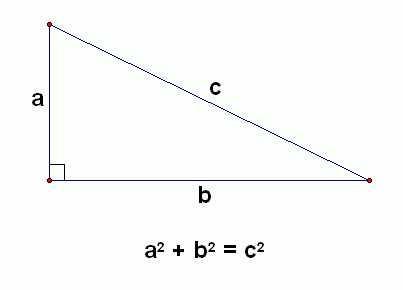
Problems involving the sides of right triangles require the use of the Pythagorean theorem. First, what is a right triangle? They are triangles that have a 90 degree angle in them. In the below picture only the red triangle is a right triangle.


The Pythagorean theorem is a relationship the sides of a right triangle all have.

It isn't so important which side "a" and "b" are, but "c" must be across from the right angle. "a" and "b" are called legs and "c" is called the hypotenuse. 

Here is an example of a right triangle problem. How far is the base of the ladder from the wall in the picture below.
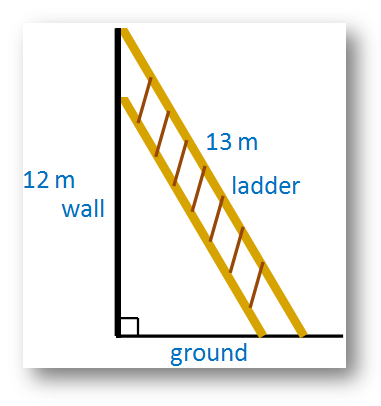


Here is a demonstration on how to solve this problem. Now try some on your own. 


Now try a few on your own.
  • Practice Problem 1:  


  • Practice Problem 2:  


Interest Word Problems

Interest Problems are those that usually involve borrowing money, lending money, or investing. Here is a example problem.
  • Suppose Karen has $1000 that she invests in an account that pays 4% interest compounded yearly. How much money does Karen have at the end of 5 years to the nearest dollar?

The formula that governs interest situations is 


is the total accumulated amount
P is called the Principal (the beginning amount of money before any interest is applied)
r is the yearly interest rate
t is the number of years the interest is being applied

Let's take a look at how to use this formula to solve the above problem. 

  • Practice Problem 1:  William wants to have a total of $4000 in two years so that he can put a hot tub on his deck. He finds an account that pays 5% interest compounded yearly. How much to the nearest dollar should William put into this account so that he’ll have $4000 at the end of two years? [here is the solution, don't peak until you've tried it.]


  • Practice Problem 2:  Kelly puts her high school graduation money into an account and leaves it there for 4 years while she goes to college. If she receives $750 in graduation money that she puts it into an account that earns 4.25% interest annually. How much will be in Kelly’s account at the end of four years? [here is the solution, don't peak until you've tried it.]


Sunday, February 1, 2015

DRT Word Problems

DRT Word Problems are also sometimes called uniform motion problems. They always involve something moving. Whatever is moving can be described by the formula


or

the distance something travels = the speed it travels * amount of time it travels

You probably have done problems using this formula before. In this class, we will build off of those earlier experiences by giving you situations in which two things are moving. Here is an example.


What is really helpful for setting these problems up is a box diagram. 


Now whenever we jump to start filling in the boxes. The problem is that many students get lost when they start this way. They end up with a bunch of boxes filled in, but no idea what the equation should be. My recommendation is to start be asking yourself how the two trips are related. This is where the equation always come from. What am I talking about here? Let's look at an example.


Now try a few on your own.


Sunday, January 25, 2015

Work Rate Problems

These are many students favorite word problems. The reason is that they are fairly easy to handle. Here is an example.


The relationship that underlies all work situations is

This stands for 

the amount of work you do = rate at which you work * amount of time you work for

Now when you work together with someone else, you add your work rates together. So we change the equation to 


There are lots of ways to do these problems, but these are the steps I like to use
1. Identify the rates of the different people in the problem
2. Add the rates together
3. Put them in the equation
4. Solve the equation. (There is a shortcut to solving that many students pick up on here.)
5. Make sure you show all four parts in your answer.

Let's look at some examples. 

Now try a few on your own.

Thursday, January 22, 2015

Area Word Problems

This kind of word problem involves a shape (usually a rectangle or triangle) that you know the area of and are asked to find the dimensions. For the rectangle, you have to find the length and width. For the triangle, the base and height. Here is an example.

The length of the top of a table is 5m greater than the width. The area is 84 square meters. Find the dimensions of the table. 

The background for all of these problems is knowing the area formulas for the basic shapes.

adapted from http://domeprep.com/sat-act-prep/sat-course/on-demand/study-guides/basic-geometry

 Let's look at some examples. 


Monday, January 19, 2015

The Sum of Squares Problem

Here is the word problem:

The sum of the squares of two consecutive numbers is 85. Find the two numbers.

Here is a demo of me working through the problem.


You might be asking yourself where the four parts are? I was focused on explaining in the demo, but on a test we want to be more careful about our presentation of the solution. Here are the four parts of the answer that I want to make sure are on my paper before I turn it in.

Renting a Car Word Problem

Here is the word problem:

Value Rent-A-Car rents a luxury car at a daily rate of $41.72 plus 10 cents per mile. A business person is allotted $130 for car rental each day. How many miles can the business person travel on the $130?

Here is a demo of me working through the problem.


You might be asking yourself where the four parts are? I was focused on explaining in the demo, but on a test we want to be more careful about our presentation of the solution. Here are the four parts of the answer that I want to make sure are on my paper before I turn it in.

Parking at a Hospital Word Problem

Here is the word problem:

A hospital parking lot charges $2 for the first hour or part thereof, and $1 for each additional hour or part thereof. A weekly pass costs $47 and allows unlimited parking for 7 days. If each visit Jonny makes to the hospital lasts two and a half hours, what is the minimum number of visits for which buying a pass would be less expensive than paying each time?

Here is a demo of me working through the problem.


You might be asking yourself where the four parts are? I was focused on explaining in the demo, but on a test we want to be more careful about our presentation of the solution. Here are the four parts of the answer that I want to make sure are on my paper before I turn it in.

Finding Angles of a Triangle

Here is the word problem:

The second angle of a triangle is 55 degrees more than the first angle. The third angle is 15 degrees less than twice the first angle. Find all three angles.

Here is a demo of me working through the problem.


You might be asking yourself where the four parts are? I was focused on explaining in the demo, but on a test we want to be more careful about our presentation of the solution. Here are the four parts of the answer that I want to make sure are on my paper before I turn it in.

Consecutive Integer Practice Problem

Here is the word problem:

The product of two consecutive odd integers is 143. Find all possible such integers.

Here is a demo of me working through the problem.


You might be asking yourself where the four parts are? I was focused on explaining in the demo, but on a test we want to be more careful about our presentation of the solution. Here are the four parts of the answer that I want to make sure are on my paper before I turn it in.

A Board Problem

Here is the word problem:

A 190-inch board is cut into two pieces. One piece is four times the length of the other. Find the lengths of the two pieces. Find the length of the short piece. 

Here is a demo of me working through the problem.


You might be asking yourself where the four parts are? I was focused on explaining in the demo, but on a test we want to be more careful about our presentation of the solution. Here are the four parts of the answer that I want to make sure are on my paper before I turn it in.

Consecutive Integer Problem

Here is the word problem:

The sum of three consecutive odd integers is 189. What are the integers?

Here is a demo of me working through the problem.


You might be asking yourself where the four parts are? I was focused on explaining in the demo, but on a test we want to be more careful about our presentation of the solution. Here are the four parts of the answer that I want to make sure are on my paper before I turn it in.

Thursday, January 8, 2015

Change Your Profile Picture in Edmodo

  • Change Your Profile Picture

    Smile and say cheese!  You can now change your Profile Picture directly from your Edmodo Account Settingsor from your Edmodo Profile.

    From your Edmodo Profile:
    1. Select the “Down Arrow” icon  next to your Profile Picture on the top toolbar.
    2. Click the “Profile” option in the drop-down menu.
    3. Hover over and click on the pencil icon to edit or change Profile Picture.
    4. Click the "Upload Photo" button or "Personalize Avatar" button to launch the avatar builder.
    5. If uploading a photo, click "Upload Photo" to select the photo you’d like to use from your computer
    6. Click "Update" to begin displaying this new Profile Picture. 

    From Account Settings:
    1. Select the “Down Arrow” icon down-arrow.png next to your Profile Picture on the top toolbar.
    2. Click the “Settings” option in the drop-down menu.
    3. Click the "Change Profile Picture" button.
    4. Click the "Upload Photo" button or "Personalize Avatar" button to launch the avatar builder.
    5. If uploading a photo, click "Upload Photo" to select the photo you’d like to use from your computer
    6. Click "Update" to begin displaying this new Profile Picture.
     changeprofpic01.png

    chprofpictheo.png

Wednesday, January 7, 2015

How to Get Setup With Edmodo in Intermediate Algebra


Follow the steps below to create an Edmodo account and join our College Algebra class:
  1. Click this join URL: https://edmo.do/j/6qdkdd
  2. Select the “I’m a Student” button
  3. Fill out the registration form with a unique username and password. An email address is not required for student sign up.
  4. Select the “Sign up” button.
  5. Wait. I need to approve you as a new member before you can see anything. This shouldn't take longer than 24 hours. If it does, email me at hendree9@gmail.com.

**note: If you already have an Edmodo account, just click https://edmo.do/j/6qdkdd and login.

Tuesday, November 29, 2011

Finding the x-intercept/s of a quadratic function

You might remember an x-intercept of any graph is just a point at which the curve or line passes through the x-axis. So in the picture below. Point P and R are the x-intercepts of the parabola.

An x-intercept is a point (?,?), and you need to find both coordinates. But if you thought about it for a second, you already know one of them.....yes, you know the y-coordinate is zero. Why? Because if it wasn't then it wouldn't be on the x-axis. It would be a point somewhere above or below the x-axis.

So cool, you already have half the answer. You know the x-intercept is (?,0). Now, remember, whenever you have one coordinate of a point, and you know the equation you can always plug the coordinate you know into the equation and find the other. So to find the x-coordinate, just plug zero in for y.

Let's see this in action. Let's take the quadratic function . If we want to find the x-intercept, we remember we already know the x-intercept is (?,0). So we plug in zero for y and solve for x.

Now, how do we solve this for x? You guessed it, it's time for the quadratic formula. I got x = 2/3 and 0. What this means is this parabola has two x-intercepts (2/3,0) and (0,0).

Also see:
-intro to 11.6
-the direction/orientation of the parabola
-the vertex of the parabola
-the line of symmetry
-the y-intercept


Finding the y-intercept of a quadratic function

You might remember the y-intercept of any graph is just the point at which the curve or line passes through the y-axis. So in the picture below. Point Q is the y-intercept of the parabola.

The y-intercept is a point (?,?), and you need to find both coordinates. But if you thought about it for a second, you already know one of them.....yes, you know the x-coordinate is zero. Why? Because if it wasn't then it wouldn't be on the y-axis. It would be a point somewhere on either side of the y-axis.

So cool, you already have half the answer. You know the y-intercept is (0,?). Now, remember, whenever you have one coordinate of a point, and you know the equation you can always plug the coordinate you know into the equation and find the other. So to find the y-coordinate, just plug zero in for all the x's.

Let's see this in action. Let's take the quadratic function . If we want to find the y-intercept, we remember we already know the y-intercept is (0,?). So we plug in zero for the x's and solve for y.
Simplifying the equation,

Then,

so

That means the y-intercept is (0,-5)


Also see:
-intro to 11.6
-the direction/orientation of the parabola
-the vertex of the parabola
-the line of symmetry
-the x-intercepts

Finding the line of symmetry

You might have noticed every parabola has a line of symmetry running down it's middle.

The line of symmetry is always a vertical line no matter whether the parabola is an "uppie" or "downie". Vertical lines have a funny form, they are always written x = n, where n is just some number. Here's an example,

This line's equation is x=3.

How do we find the vertical line that is a parabola's line of symmetry? We observe that the line of symmetery always runs through the vertex of the parabola, so whatever the x-coordinate of a parabola's vertex is, that will give you the equation of the parabola's line of symmetry.

Let's see an example. Take the quadratic function . We note
a= 3
b= -2
c= 0
Then we find the x-coordinate of our vertex using the formula -b/(2a). {Note: this is detailed in a previous post}. -b/(2a) = 2/(2*3) = 2/6 = 1/3. So we know this much about our vertex (1/3, ?). We could go on and find the y-coordinate of the vertex, but we have all we need to know to write the line of symmetry.
It's x = 1/3.


Also see:
-intro to 11.6
-the direction/orientation of the parabola
-the vertex of the parabola
-the y-intercept

-the x-intercepts

Finding the vertex of a quadratic function

Every parabola has a vertex. Depending on the orientation of the parabola, it will always be the highest or lowest point on the parabola. Here is a picture of two parabolas graphed on the same coordinate plane with the vertices labeled.

The first thing you should remember is that the vertex is a point. And points look like this (3,5) Therefore you have to find two coordinates, the x-coordinate and the y-coordinate.

Step 1: Finding the x-coordinate of the vertex
If you are given a quadratic equation, say . All you have to do is note a,b, and c.
a = -5
b = 2
c = -5
And then use a little formula. to calculate the x-coordinate of the vertex.
In our example, is . Simplifying, which is 1/5. So we know this much about our vertex now, it is a point (1/5, ?)


Step 2: Finding the y-coordinate of the vertex
One tends to forget this, but whenever you have one coordinate of a point, and you know the equation you can always plug the coordinate you know into the equation and find the other. So in our case, we know the x-coordinate, we are going to plug it into our quadratic function, and find out our y-coordinate. In step 1 we figured out that the x-coordinate is 1/5 and we also have our function . So, watch the magic, we just plug in 1/5 for every "x" in our function: . Now we simplify the right side,

some more

and some more

and...

finally!

There's our y-coordinate!
So our vertex is (1/5, -24/5)

Here is a little demo I did from a question in the homework. (Watch out there is an embarrassing bit of subtraction in there. The y-coordinate should be -10, not -18.)


Also see:
-intro to 11.6
-the direction/orientation of the parabola
-the line of symmetry
-the y-intercept

-the x-intercepts